John Carmack Working Again With John Romero
It's the summer of 2022 and I'm sitting in a Brighton hotel room with John Romero. It's okay, nothing shady's going on - his wife Brenda, another supremely achieved game programmer, is here too. John is quiet and considered, a world away from the bombast and bloodshed of the game that made his name, and that of id Software: DOOM.
"When I first got into the manufacture, in 1987, the guy who hired me was 26 and I was 20, and he told me programmers burn out at 30," John tells me. "He was like, 'And then, do whatever you can, now.' Really? I'd been doing this since I was 11, and was having tonnes of fun, and at 20 I was ready to start kicking ass."
Watch the trailer for the rereleased DOOM, DOOM 2 and DOOM 3, beneath…
Fast-forward six years and Romero's career, which has already taken in projects for Infocom and Softdisk Publishing - he started young, designing his first game equally a teenager - kicks a whole new level of ass with a title that arrives in a torrent of hype, at least partly generated by its own makers. Long before DOOM is ready to be played, the small team at id Software - a studio co-founded by Romero alongside three other ex-Softdisk staffers: John Carmack, Adrian Carmack, and Tom Hall - put out a printing release dissimilar any other. To pull simply a snippet from it:
"Heralding another technical revolution in PC programming, id Software'due south DOOM promises to push dorsum the boundaries of what was thought possible on a 386sx or meliorate computer… Stationed at a scientific enquiry facility, your days are filled with tedium and paperwork. Today is a bit different. Wave later wave of demonic creatures are spreading through the base, killing or possessing everyone in sight. Every bit y'all stand knee-deep in the dead, your duty seems articulate-yous must eradicate the enemy and discover out where they're coming from. When you detect out the truth, your sense of reality may be shattered!"
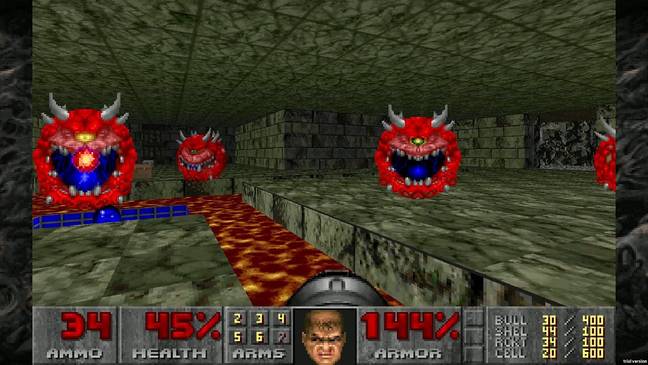
More than notably, the press release - issued on January 1st 1993, when the game wouldn't release until mid-Dec - talked up a number of features that its makers didn't fifty-fifty know they could pull off. Foremost amongst them was a "multiple player selection" supporting "four players over a local network, or two players by modem or serial link."
"I nonetheless remember the day multiplayer started but barely working in DOOM," John Carmack told Kotaku in 2013. "I was strafing back and forth on one system and looking over my shoulder at the other reckoner, watching the marine sprite slide side to side in front of the other player'due south pistol. There was a consistency failure before the first frag was truly logged, only it was blindingly obvious that this was going to be crawly."
---
"We knew, fifty-fifty and then, that what nosotros were going to put in the game was going to exist better than annihilation that anyone was making at the time."
---
"It was only crazy, especially as we had just started making the game," Romero told PC Gamer in 2020, thinking back to the press release's boasts, its claims that id Software weren't certain of backing up. "But nosotros knew, even then, that what we were going to put in the game was going to be amend than anything that anyone was making at the time."
Romero and the id Software team had already made a splash with 1992's Wolfenstein 3D, a offset-person shooter that did much to popularise the genre later on and so-and then experiments with the perspective in titles like 1990's Corporation by Cadre Design and Xanth Software F/X'due south groundbreaking 1987 release MIDI Maze. Those older titles permit you await downward the butt of a gun, sure, but they felt ho-hum, stuttering, and compromised. In contrast, Wolfenstein 3D was fast, intuitive, and roughshod. But it wasn't plenty.
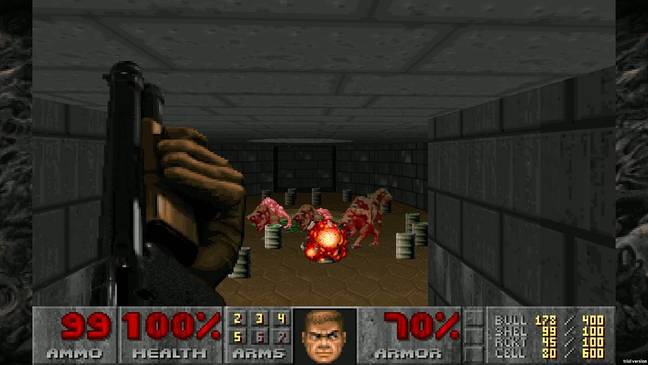
"Afterward Wolfenstein, we had to brand something that was fifty-fifty more out there," Romero told Venturebeat in 2013, on DOOM's 20th anniversary. "We had to one-up ourselves." Speed was again on the carte du jour, as Romero continued: "Yous're going 50 miles an hour running or some craziness. Merely I don't care what the calculation is. Does it experience adept to me? That'south all I care nearly as a game player."
That game feel is such an important aspect of DOOM's success. Played today, a full 28 years after its debut, the original DOOM is breathtakingly brisk and buttery smoothen. It'south all the same an incredible corporeality of fun - a streamlined, astonishingly pure strain of what FPS games have come to be, with no padding added. That DOOM gives you just a few tools and loads of opportunities to apply them is a very different approach to games today which load up on guns to kill your friends and enemies alike with, but tin can easily overwhelm with loadouts and build choices.
---
"For DOOM, information technology was really important that every time you got a new weapon, it never made any previous weapons useless."
---
"I would rather have fewer things with more significant, than a million things you don't identify with," Romero told The Guardian in 2019, talking well-nigh modern FPS games. He continued: "For DOOM, it was really important that every fourth dimension you got a new weapon, it never made whatsoever previous weapons useless. That was a critical design characteristic. We're going to add a new thing that can't negate anything that came before."
That'southward why, even though you pick upward the shotgun early on in DOOM, it never becomes redundant the deeper y'all progress. Certain, the infamous BFG 9000 is a blast - but is it equally much fun every bit rampaging through these halls with a chainsaw churning up the demonic ranks earlier you? For me, information technology never was. Instead, DOOM was shut-quarter shotgun combat played out at hyper speed, and I still go a tremendous kicking out of playing it today (virtually recently through its Switch port).
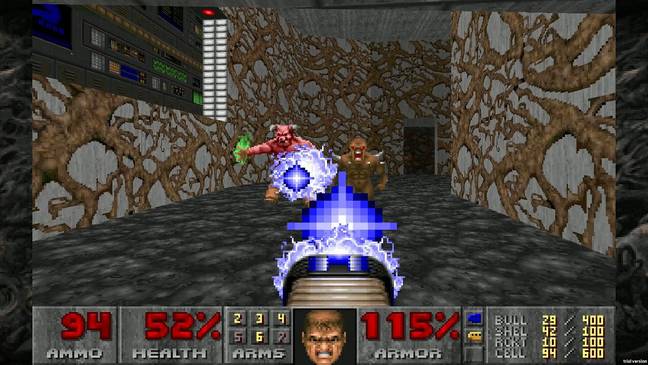
DOOM's legacy is well established. Asked himself for his thoughts on what it helped to pave the way for, Romero told Venturebeat: "The first-person shooter genre. Video game violence. Multiplayer. Maybe esports. The game engine. Modifying games. The mod community." All true. There'southward also the small matter that Romero himself coined the term "deathmatch": "We had to give names to things. I came up with 'deathmatch'. What are we doing? We're playing a match to the death. So that'south a cool word, a prissy chemical compound thing. I'g always combining words. It came naturally."
He continued, in the aforementioned piece: "At the beginning of DOOM, we said, 'We need to make the greatest game that we could ever play.' Any we could imagine that would be the best thing we could play, nosotros wanted to make that game." Mission, absolutely accomplished.
Dorsum to that hotel room, Brighton, 2018. I'g asking Romero why he still does what he does. "Work is not making games. Making a game is ever fun." He may never top DOOM when information technology comes to genuine game-changers, merely almost three decades on from the shooter that shook up the world, John Romero'due south bright-eyed sparkle of "Okay, what's next" creativity hasn't dulled in the slightest. The man loves games, the gamers love this man, and long may that continue.
This piece is part of a series profiling influential game creators, truthful masters of style, and their key works. Read previous entries: Fumito Ueda (Shadow of the Colossus), Amy Hennig (Uncharted), Hideki Kamiya (Devil May Cry), Hideo Kojima (Metal Gear Solid), Roberta Williams (King's Quest), Paul Cuisset (Flashback).
---
This editorial content is supported by Philips OneBlade . Philips is committed to providing products that fit into every individual's life, to suit every personality'south idea of mode. Every one of united states is unique, and every one of us feels comfortable and confident in unlike ways - and the flexibility of Philips OneBlade ensures that anyone can express themselves in a way that's all about them. Find more information here .
Source: https://www.gamingbible.co.uk/features/doom-maker-john-romero-on-how-the-game-changed-fps-titles-20211222
0 Response to "John Carmack Working Again With John Romero"
Post a Comment